
How to Estimate a Product's Carbon Footprint Using Only a Product URL
Discover how AI can analyse a product webpage, estimate its carbon footprint, and generate a professional carbon report in minutes—without requiring complex sustainability expertise.
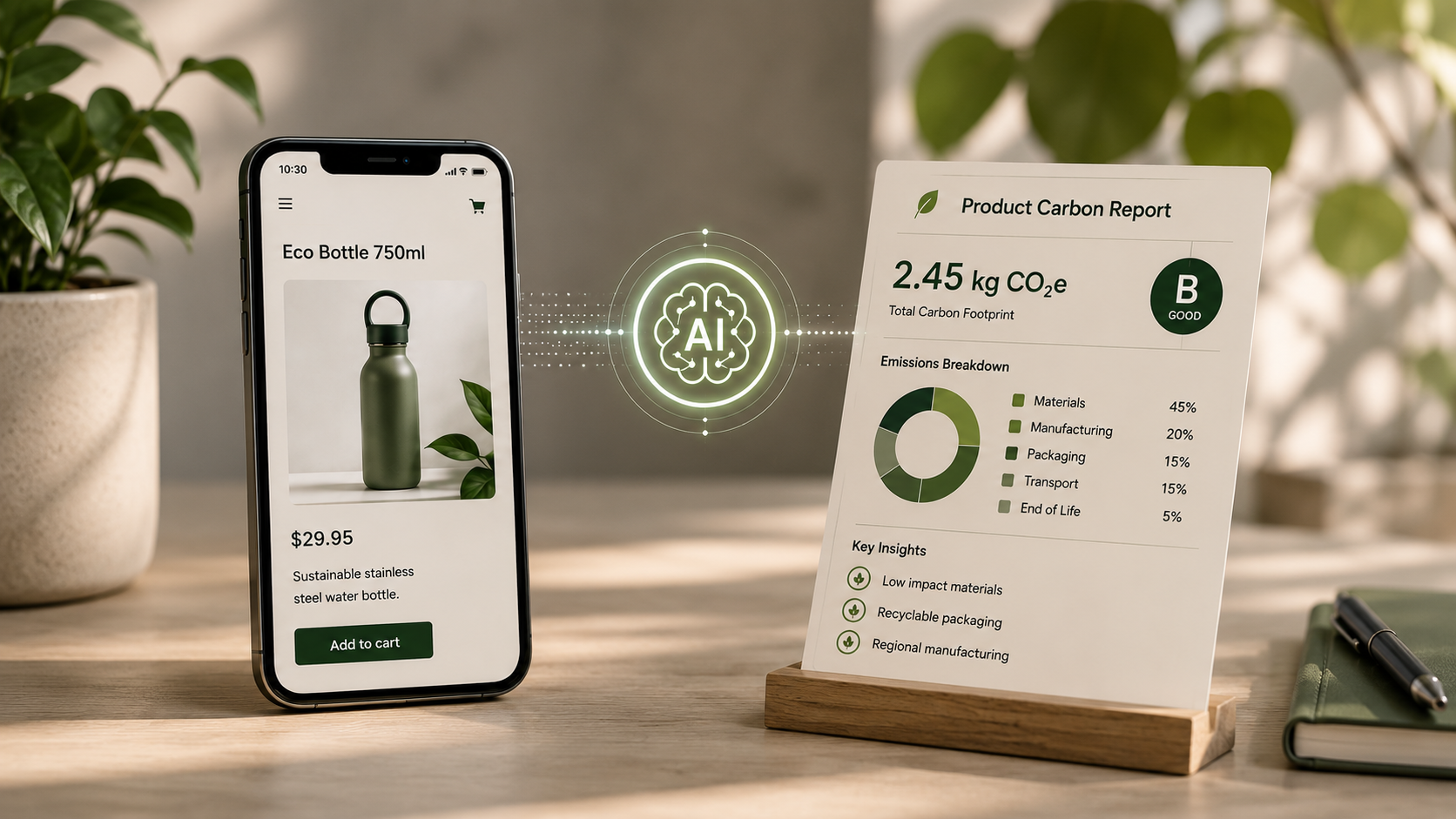
Calculating a product's carbon footprint has traditionally been a complex, time-consuming process requiring specialist knowledge, detailed supplier data, and expensive lifecycle assessments.
Today, advances in artificial intelligence are making it possible to generate useful carbon footprint estimates much faster by analysing publicly available product information.
Instead of manually collecting specifications from multiple sources, AI can extract key product details from a product webpage and combine them with recognised emissions data to produce a professional Product Carbon Footprint report.
Here's how the process works.
Why Traditional Carbon Assessments Take So Long
A conventional Product Carbon Footprint study often involves gathering information from manufacturers, suppliers, logistics providers, and material databases.
This process may include:
- Material identification
- Product weights
- Manufacturing processes
- Packaging specifications
- Shipping routes
- End-of-life assumptions
Collecting this information manually can take days or even weeks, depending on the complexity of the product and the availability of data.
For many businesses, this level of detail isn't practical for every product in their catalogue.
Step 1: Start with a Product URL
Every product page already contains valuable information.
For example:
- Product name
- Description
- Materials
- Dimensions
- Images
- Product category
- Manufacturer details
- Packaging information (where available)
Rather than asking users to enter this information manually, URLCarbon begins by analysing the product page itself.
Simply paste a publicly accessible product URL into the platform.
Step 2: AI Extracts Product Information
The AI engine scans the webpage and identifies relevant product characteristics.
Depending on the information available, this may include:
- Product type
- Primary materials
- Secondary materials
- Product dimensions
- Estimated weight
- Manufacturing location (if disclosed)
- Packaging information
- Sustainability certifications mentioned on the page
The quality of the available information directly influences the confidence score included in the final report.
Step 3: Fill the Gaps with Intelligent Assumptions
Not every product page provides complete information.
For example, a listing might not include the product's weight or packaging details.
In these situations, URLCarbon uses category-specific assumptions and engineering estimates based on recognised methodologies to fill reasonable gaps where appropriate.
These assumptions are clearly reflected in the report's confidence score, helping users understand the reliability of the estimate.
Step 4: Estimate Lifecycle Emissions
Once the product information has been gathered, URLCarbon estimates emissions across the major lifecycle stages.
These may include:
- Raw material extraction
- Material processing
- Manufacturing
- Packaging
- Transportation
- End-of-life disposal or recycling
Rather than focusing on a single stage, the estimate considers the product as a whole to provide a more complete picture of its environmental impact.
Step 5: Generate a Professional Carbon Report
Within minutes, URLCarbon produces a comprehensive report that includes:
- Estimated Product Carbon Footprint (kg CO₂e)
- Carbon Rating
- Confidence Score
- Carbon Hotspots
- Environmental Strengths
- Improvement Opportunities
- Circularity Assessment
- ESG Snapshot
- Procurement Summary
- AI Executive Summary
The report is designed to be easy to understand while remaining suitable for sharing with customers, procurement teams, and internal stakeholders.
Why Confidence Scores Matter
No two product pages contain the same level of detail.
Some manufacturers publish comprehensive specifications. Others provide only a brief product description.
Rather than pretending every estimate has the same certainty, URLCarbon includes a confidence score based on the quantity and quality of information available.
This provides greater transparency and helps users understand where assumptions have been made.
Who Can Benefit?
AI-assisted carbon estimation can support many different organisations. Examples include:
- Promotional product suppliers
- Manufacturers
- Distributors
- Procurement teams
- Retailers
- Sustainability consultants
- Marketing agencies
- Corporate buyers
It can also help businesses prioritise which products may warrant more detailed lifecycle assessments in the future.
Why This Matters
Environmental information is becoming increasingly important in purchasing decisions.
Businesses are looking for practical ways to understand product impacts without undertaking lengthy assessments for every item.
AI-assisted estimation offers a scalable approach that can help organisations generate useful product-level insights quickly while remaining transparent about assumptions and confidence levels.
Frequently Asked Questions
Can AI calculate an exact carbon footprint?
No. AI can assist in estimating a Product Carbon Footprint using available product information, recognised emissions factors, and transparent assumptions where necessary. The estimate should be interpreted in the context of the report's confidence score.
Does every product page contain enough information?
Not always. The amount of available information varies between manufacturers and retailers, which is why confidence scores are included to indicate the completeness of the underlying data.
Is this the same as a full Life Cycle Assessment?
No. A detailed Life Cycle Assessment typically requires extensive primary data collection and specialist analysis. AI-assisted Product Carbon Footprint estimation provides a faster way to generate useful product-level insights, particularly when a full LCA is not practical.
How long does the process take?
In most cases, the analysis and report generation process can be completed within minutes, depending on the complexity of the product and the availability of information.
Can businesses use these reports internally?
Yes. Many organisations use Product Carbon Footprint estimates to support procurement decisions, product comparisons, sustainability initiatives, and internal discussions about environmental impact.
Final Thoughts
Understanding the carbon footprint of products no longer needs to be a lengthy or highly specialised process.
By combining artificial intelligence with recognised carbon accounting methodologies, businesses can generate transparent, informative Product Carbon Footprint estimates from publicly available product information.
This enables organisations to begin understanding product-level emissions faster while providing clear insight into the assumptions and confidence behind every estimate.
Generate Your First Product Carbon Report
Ready to see how it works?
Paste a publicly accessible product URL into URLCarbon and receive a professional Product Carbon Footprint report in minutes.
Ready to understand your product's carbon footprint?
Paste a product URL and generate a professional, boardroom-ready carbon report in minutes — aligned with ISO 14067 and the GHG Protocol.