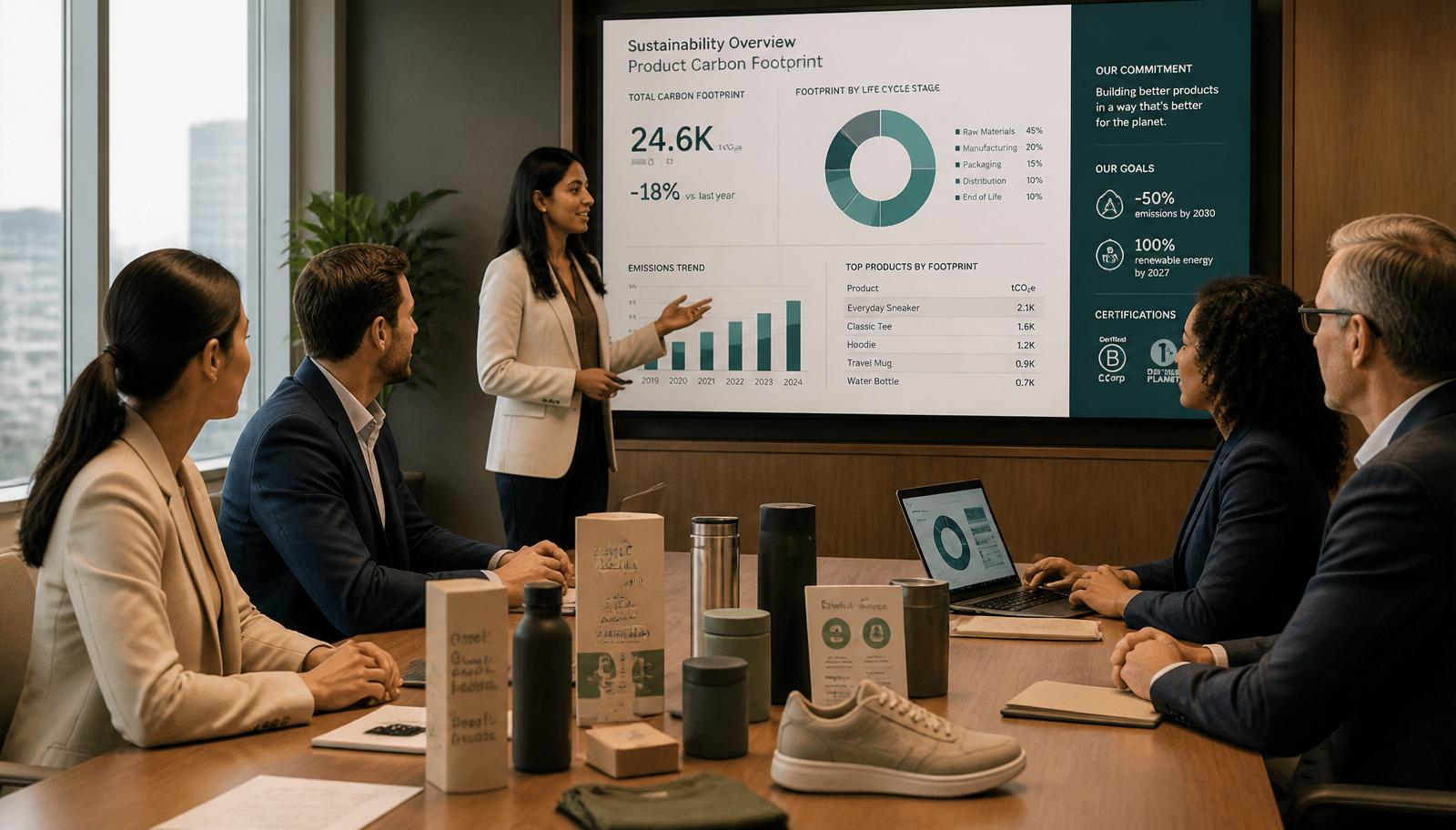
What Is a Product Carbon Footprint? (And Why Your Customers Are Starting to Ask)
A clear guide to Product Carbon Footprints — what they measure, why buyers now ask for them, and how AI is making carbon reporting faster and more accessible for every business.
If you've noticed more customers asking about sustainability, carbon emissions, or environmental impact, you're not imagining it.
Businesses of all sizes are beginning to ask a new question before making purchasing decisions:
A Product Carbon Footprint (PCF) helps answer that question by estimating the greenhouse gas emissions associated with producing, transporting, using, and disposing of a product.
Once reserved for large corporations with dedicated sustainability teams, carbon footprint reporting is becoming more accessible. Advances in AI and better product data now make it possible to estimate footprints much faster than traditional manual studies.
This guide explains what a Product Carbon Footprint is, why it matters, and how businesses can start understanding the environmental impact of their products.
What Is a Product Carbon Footprint?
A Product Carbon Footprint (PCF) is an estimate of the total greenhouse gas emissions associated with a product throughout its lifecycle.
These emissions are usually expressed as:
kg CO₂e (kilograms of carbon dioxide equivalent)
CO₂e combines the warming effect of different greenhouse gases into a single comparable value.
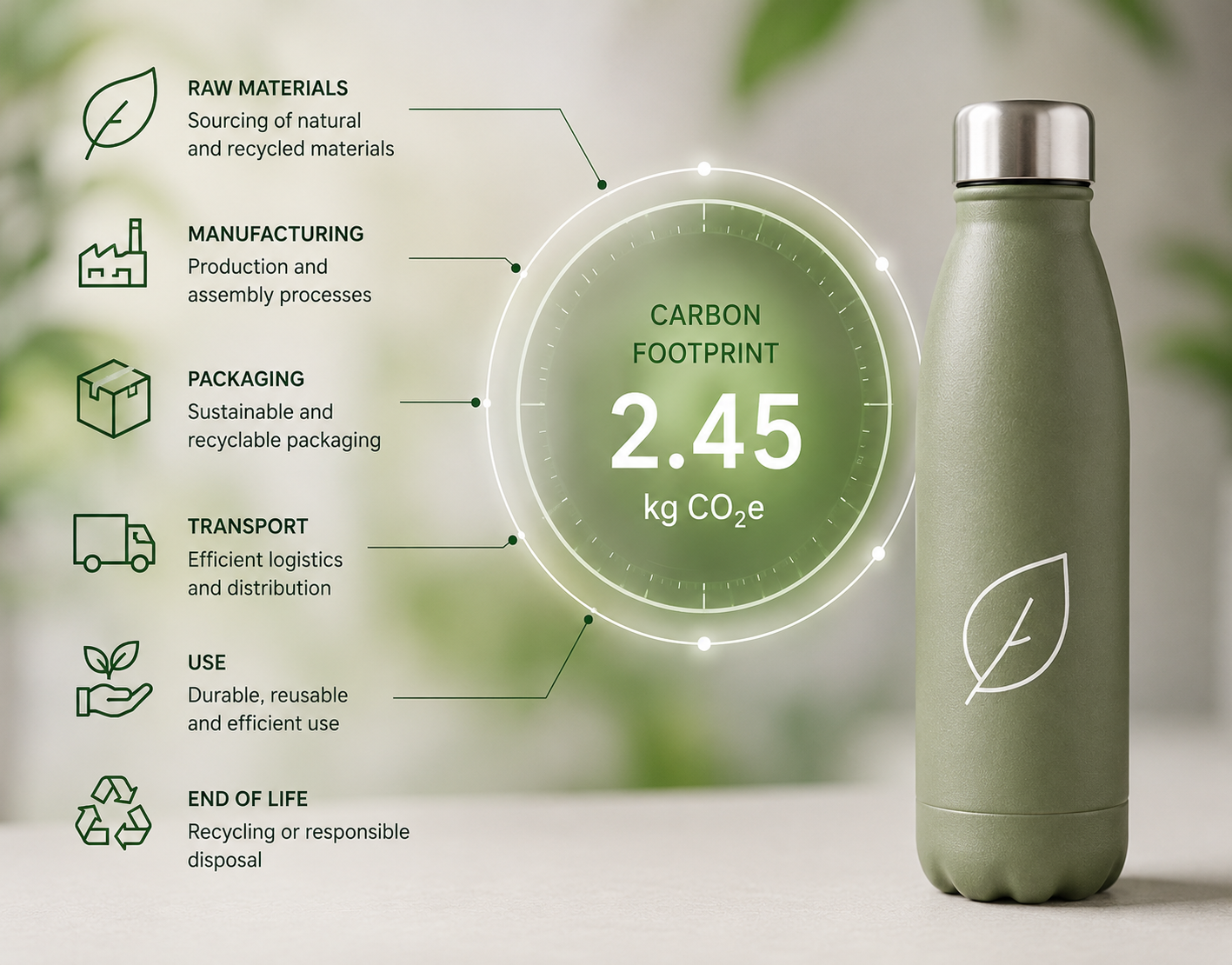
For example, a stainless-steel drink bottle might have an estimated Product Carbon Footprint of 2.4 kg CO₂e — meaning producing, packaging, transporting and disposing of that product is estimated to result in greenhouse gas emissions equivalent to releasing 2.4 kilograms of carbon dioxide.
What Contributes to a Product's Carbon Footprint?
A product's footprint is influenced by many factors. These typically include:
- Raw materials
- Manufacturing processes
- Factory energy use
- Product weight
- Packaging materials
- Shipping distances
- Transport methods
- Product lifespan
- End-of-life disposal or recycling
Even two products that appear almost identical can have different footprints because of differences in materials, manufacturing locations, transport routes, or packaging.
Why Are Businesses Asking for Carbon Data?
Environmental information is becoming increasingly important in purchasing decisions.
Companies may request carbon information when they want to:
- Compare suppliers
- Support sustainability initiatives
- Inform procurement decisions
- Understand environmental impacts
- Respond to customer requests
- Prepare for ESG reporting
- Improve internal decision-making
Providing accessible carbon information can also help businesses demonstrate transparency and make it easier for customers to compare products.
Traditional Carbon Assessments
Historically, creating a Product Carbon Footprint required specialist consultants. The process often involved:
- Collecting supplier data
- Reviewing manufacturing information
- Analysing materials
- Building lifecycle assessment models
- Producing technical reports
Depending on complexity, this process could take weeks or months and cost hundreds or thousands of dollars.
While detailed lifecycle assessments remain important for many applications, they may not always be practical when businesses simply want an initial understanding of a product's environmental impact.
How AI Is Changing Carbon Reporting
Artificial intelligence is helping automate parts of the assessment process.
Instead of manually gathering product information from multiple sources, AI can help identify:
- Product descriptions
- Materials
- Dimensions
- Product weight
- Manufacturing information (where available)
- Packaging details
- Transport assumptions
These inputs can then be combined with recognised emissions factors and lifecycle assessment methodologies to produce an estimated Product Carbon Footprint.
Understanding Confidence Scores
Not every product page contains the same level of information.
Some manufacturers publish detailed specifications. Others provide only basic descriptions.
For this reason, carbon reports often include a confidence score that reflects the quality and completeness of the available data used in the estimate.
- Higher confidence generally means more product-specific information was available.
- Lower confidence may indicate that more assumptions were required.
What Does a Product Carbon Report Include?
A modern carbon report can provide much more than a single number. Typical reports may include:
- Estimated Product Carbon Footprint
- Carbon Rating
- Confidence Score
- Carbon Hotspots
- Environmental Strengths
- Improvement Opportunities
- Circularity Assessment
- ESG Snapshot
- Procurement Summary
- AI Executive Summary
These insights help businesses understand not only the estimated emissions, but also the factors influencing them.
How URLCarbon Simplifies the Process
URLCarbon is designed to make product carbon reporting more accessible.
Instead of manually collecting product information, users simply paste a product URL. The platform then:
- Analyses the product page
- Identifies relevant product information
- Estimates lifecycle emissions using recognised methodologies
- Generates a professional PDF carbon report within minutes
The methodology is aligned with recognised carbon accounting principles, while clearly communicating assumptions and confidence levels to support transparency.
Frequently Asked Questions
What is CO₂e?
CO₂e stands for Carbon Dioxide Equivalent, a standard unit used to compare the warming effects of different greenhouse gases.
Is a Product Carbon Footprint the same as a Life Cycle Assessment?
Not exactly. A full Life Cycle Assessment (LCA) evaluates multiple environmental impacts. A Product Carbon Footprint focuses specifically on greenhouse gas emissions.
Why do two similar products have different footprints?
Small differences in materials, manufacturing, packaging, transport, and supplier practices can all influence a product's estimated emissions.
Can AI calculate a Product Carbon Footprint?
AI can assist by extracting product information, estimating missing data where appropriate, and combining recognised emissions factors with lifecycle methodologies to produce an estimate. The quality of the estimate depends on the available information and the assumptions required.
Who uses Product Carbon Footprints?
They can be useful for manufacturers, suppliers, procurement teams, sustainability professionals, retailers, and organisations that want to better understand the environmental impact of products.
Final Thoughts
Understanding the environmental impact of products is becoming increasingly important for businesses across many industries.
While detailed lifecycle assessments remain valuable, AI-powered estimation tools are helping make Product Carbon Footprints more accessible, allowing organisations to generate useful insights faster and at a lower cost.
As product data continues to improve and sustainability reporting evolves, having reliable carbon information available at the product level is likely to become an increasingly valuable part of business decision-making.
Ready to understand your product's carbon footprint?
Paste a product URL and generate a professional, boardroom-ready carbon report in minutes — aligned with ISO 14067 and the GHG Protocol.